Türkçe
 English
 Deutsch
A potential customer searches on Google, clicks through to your website, and starts waiting. Even if the menu has appeared, the product image or the main content describing your service may still not be on the screen. Before the visitor can evaluate your business, they have to wait for the page to load.
LCP optimization is the performance work that makes the largest content element in a page's initial view appear sooner. For businesses, the goal is to get visitors to the content they are looking for faster and to reduce waiting time on key pages.
In this guide, we will look at how LCP is measured, which problems should be investigated, and how the optimization process can be planned in a sample business scenario.
What is LCP and what does it measure?
LCP is short for Largest Contentful Paint. It measures the time from when a page starts loading until the largest eligible image, text block, or video content in the viewport is rendered.
On an e-commerce page, the LCP element may be the product photo; on a service page, a large hero image; and on a blog post, a block of text. LCP does not indicate the moment when all the files on the page have finished loading. Google web.dev LCP guide
What is a good LCP value?
| LCP time | Assessment |
|---|---|
| 2.5 seconds or less | Good |
| More than 2.5 seconds, up to 4 seconds | Needs improvement |
| More than 4 seconds | Poor |
Mobile and desktop are assessed separately, based on the 75th percentile of page loads. For a good result, the goal is for LCP to be 2.5 seconds or less for at least 75% of visits. A single fast test does not show that this condition is met. LCP thresholds and measurement approach
Why is LCP optimization important for businesses?
From a business perspective, the value of performance work should be assessed together with the stage at which the customer is waiting.
A delayed photo on a product page can make it harder to examine the product; delayed main content on a service page can make it harder to understand the offer. For this reason, it is not enough to set optimization priorities based only on the slowest page. The page's visit count, its role in organic traffic, and its place in the sales process also matter.
For example, an archive page with few monthly visits and a service page that brings in a significant share of quote requests may not deserve the same priority. For a business, the right starting point is the pages where performance problems and commercial importance overlap.
What is the impact of LCP on SEO?
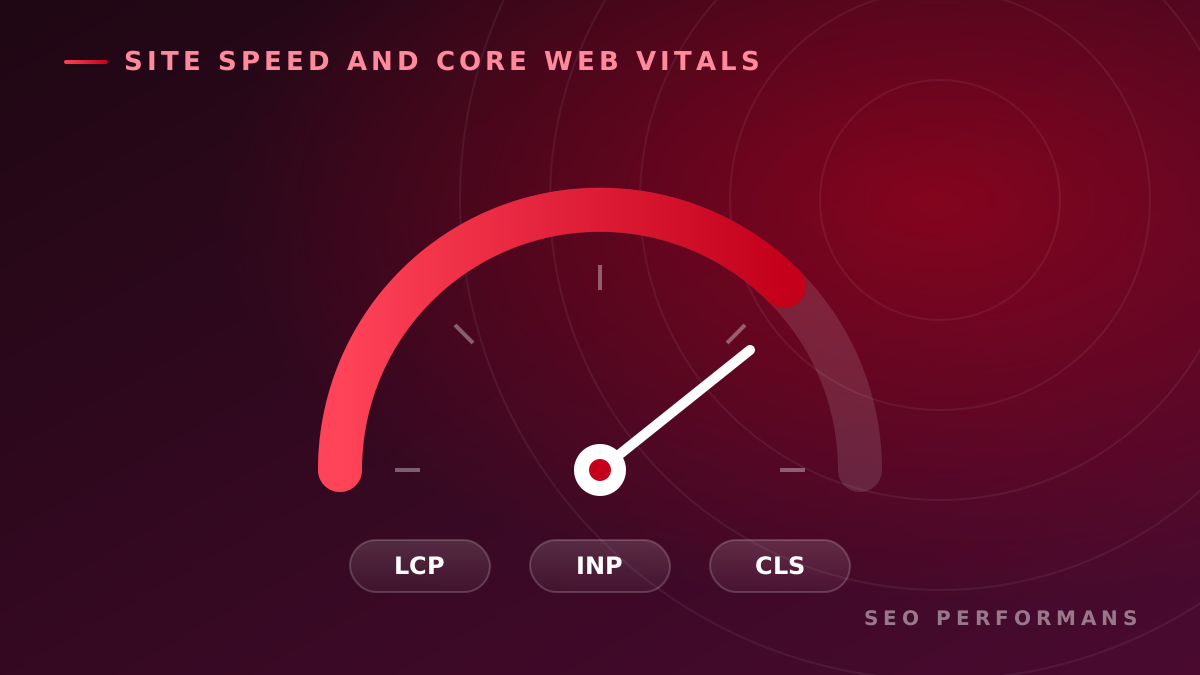
LCP is one of the Core Web Vitals metrics Google uses to evaluate user experience. The other metrics cover responsiveness to interactions through INP and visual stability through CLS. Google recommends good Core Web Vitals values and takes them into account as part of the overall page experience. Google Search Central
For this reason, LCP work should be included in your technical SEO plan. However, it would be wrong to equate a specific time saving with a specific increase in rankings or sales. Whether the content meets search intent, how accessible the page is, and how strong the offer is should each be assessed separately.
How do you identify an LCP problem?
The first step is to build a sample of your important pages. If the home page, service page, category page, and product page use different templates, each one should be reviewed.
PageSpeed Insights provides two types of data:
- Real-user data: When sufficient data is available, it shows the user experience over the last 28 days via CrUX.
- Lab data: Generated with Lighthouse under specific test conditions, it helps you investigate problems.
The absence of real-user data does not mean the page is fast. You should also check whether the report shows data for the inspected URL or for the origin as a whole. PageSpeed Insights documentation
On the business side, it is useful to add the following information to the baseline record:
| Record | Purpose |
|---|---|
| Page and template reviewed | Defining the scope of the problem |
| Mobile or desktop measurement | Isolating the affected experience |
| Data source and date range | Making comparisons meaningful |
| Organic entries and conversion goal | Setting business priorities |
| Recent design and infrastructure changes | Investigating possible causes |
This record makes it easier to give a concrete answer to the question "What changed?" at the end of the project.
How is LCP optimization done?
On a page with images, delays can occur during the initial server response, the start of the image request, the download of the file, or the rendering of the content.
For this reason, the technical review focuses on the following areas:
| Area of review | Possible action |
|---|---|
| Initial response delay | Reviewing server processing, caching, and redirects |
| Late discovery of the image | Making the main image discoverable in the initial HTML |
| Lazy loading on the LCP image | Removing lazy loading from this image |
| Large image file | Evaluating appropriate sizing, compression, and modern formats |
| Priority issue | Using fetchpriority or preload on required resources |
| Render delay | Reducing render-blocking CSS and JavaScript work |
Reducing file size alone may not be enough: even if the image is downloaded, LCP is delayed if it stays hidden until JavaScript finishes. The action should be chosen based on the bottleneck found in the measurement. Google's LCP optimization guide
The explanation a business should ask for here is simple: Which change will remove which delay, and how will the result be verified?
Case study: Main content that appears late on a service page
The scenario below is prepared for illustrative purposes. It is not an actual client result or a performance guarantee.
Let's consider a business that provides corporate consulting services. Organic visitors land directly on the service page. The business wants to receive more quote requests but suspects a problem with the mobile loading experience.
1. Starting point
In the sample scenario, let's say the median LCP value from lab tests repeated under the same conditions is 4.8 seconds. This value should not be presented as a 75th percentile measurement of real users.
Let's assume the review shows that the main image is added to the page later by an animation component. The project team chooses removing this dependency, without lowering image quality, as the first experiment.
2. Implementation plan
The work is first tested on a single service page. The design team checks the appearance, the development team checks the loading behavior, and the marketing team checks the quote form and tracking events.
Acceptance criteria are set before release:
- The main content and brand appearance must be preserved.
- The quote form must work without issues.
- Analytics and conversion events must not be lost.
- The LCP target must be evaluated in comparative tests.
For example, a lab LCP of 2.5 seconds or less can be chosen as the first technical target. This is not an achieved result; it is the target set to verify the implementation.
3. Evaluating the result
After the change, the same test conditions are repeated. Then, once there is sufficient real-user data, the trend in the mobile experience is monitored.
The business also tracks form start and form completion rates from the service page. If a campaign, pricing, or form design has also changed in the meantime, the entire difference in conversions cannot be attributed to the LCP work.
The output of this case approach is not just a speed score: The business can see which problem was addressed, which check was performed, and what the decision to roll out more widely is based on.
The LCP optimization process with SEO Performans
In SEO Performans's LCP optimization service, the aim is to address your website's performance problems together with your business priorities. The scope of the work is defined based on your existing infrastructure and the analysis findings.
The process is planned around these questions:
Which pages should we focus on?
The pages that matter most for organic visibility and customer acquisition are identified.
Where does the delay occur?
Measurements are used to investigate the sources of the problem.
Which change should come first?
The expected benefit, implementation cost, and the page's functions are assessed together.
How should success be tracked?
Results are compared against the baseline measurement; user experience and business goals are monitored with separate indicators.
This way, beyond a generic list of recommendations, you can build an improvement plan that fits your own site.
Frequently asked questions about LCP optimization
How long does LCP optimization take?
The timeline depends on the scope of the problem. An issue that can be solved with a single template adjustment and work that requires an infrastructure change do not follow the same schedule. Implementation time and the monitoring period for results should be planned separately.
Do changes show up in reports immediately?
A lab test can be rerun after implementation. The real-user section of PageSpeed Insights, however, covers a 28-day period, so old and new experiences appear together for a while. PageSpeed Insights data coverage
Is performance work finished once LCP is good?
INP and CLS should also be reviewed. In addition, key actions such as the quote form, the menu, and checkout should be checked. A page that looks fast also needs to perform its functions without problems.
Where should I start for a free analysis?
You can share your website's address and your priority service or product page. Describing the problem you are experiencing and your goal makes it easier for the initial assessment to focus on the points that matter for your business.
Identify the LCP problems on your website
It is hard to make the right optimization decision without knowing which pages your visitors are waiting on. LCP analysis offers a starting point for investigating the reasons for that wait and determining priority steps.
Take the first step with SEO Performans to evaluate your website's loading experience and discuss LCP optimization opportunities.
Request a Free SEO Analysis